
The Orient Express

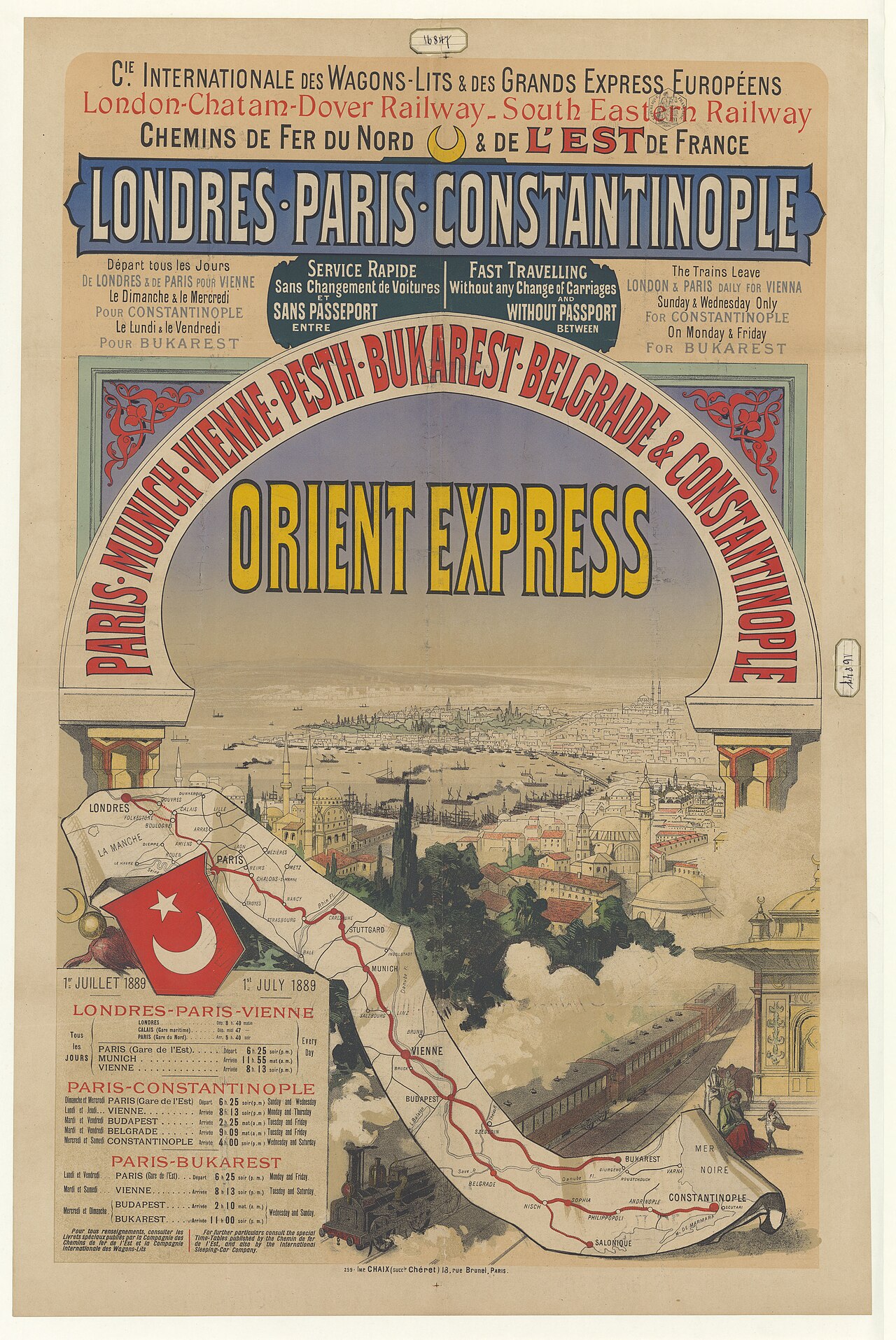
Unknown author Unknown author Imp. Chaix (Suc[ursa]le Chéret)18 rue Brunel] (Par · Public domain
The Orient Express was a long-distance passenger luxury train service created in 1883 by the Belgian company Compagnie Internationale des Wagons-Lits (CIWL). The name became synonymous with intrigue and luxury rail travel.
- field
- Railway transport
- nationality
- Belgian (company)
- known_for
- Luxury long-distance passenger train service connecting Paris and Istanbul
- created
- 1883
Lore & Background
The Orient Express embarked on its initial journey on 5 June 1883, from Paris to Munich and Vienna, but on that first trip it continued to Giurgi, Romania (via Bucharest), with the final destination being Istanbul via a ferry from Giurgi to Ruse, then a train to Varna, and finally a ship to Istanbul—so the route didn't end at Vienna. Several routes concurrently used the Orient Express name or variations. The rolling stock changed many times. Following World War II, the Orient Express struggled to maintain its preeminence amid changing geopolitical landscapes and the rise of air travel. After this, the route, still called the Orient Express, was shortened to start from Strasbourg, leaving daily after the arrival of a TGV from Paris.
Reader's Guide
It connected Paris and Istanbul, with branches to Athens, Brussels, and London. The train became synonymous with luxury and intrigue, especially during the 1930s when it carried royalty, nobles, diplomats, and business people. An ÖBB Nightjet service restored between Paris and Vienna in December 2021 was not branded as Orient Express and was cancelled in December 2025.
Did You Know?
- The first Express d'Orient left Paris for Munich and Vienna on 5 June 1883, but it actually continued to Giurgi, Romania (via Bucharest) on that first trip, with Istanbul as the final destination via a ferry from Giurgi
Origins & the Vision of a Continental Dream
His inspiration came from the Pullman night trains operating in the United States, and his ambition was even grander: a single direct rail link stretching from Saint Petersburg all the way to Lisbon, where passengers could board ocean liners bound for America. That sweeping vision proved too logistically complex to realize, so the CIWL split the dream into two separate services. The Sud Express would handle the southern route from Paris to Lisbon, while the Nord Express would claim the northern corridor, connecting Paris with Saint Petersburg.
The Grand Route Across a Divided Continent
Operating the Nord Express was an extraordinary logistical feat. The CIWL had to negotiate contracts and timetable agreements with fourteen different railway administrations, nine of them Prussian, and even arrange a ferry crossing between Dover and Ostend to link London-bound passengers into the service. The train departed from Paris and Ostend, threading through Brussels, Cologne, Hanover, and Berlin before pushing eastward through Königsberg and Dvinsk to reach Saint Petersburg. A peculiar quirk of the route was the gauge change: because Russian railway tracks were wider than those used in Western Europe, passengers traveling to or from Russia had to transfer once in East Prussia at the German-Russian border. In Paris, the Nord Express also offered a connecting service to the Sud Express heading south to Lisbon. By the standards of the pre-war era, the journey was both remarkably swift and sumptuously comfortable, earning the train a reputation as the ultimate luxury experience in European rail travel.
A Century of Shrinking Horizons
The Nord Express's original grandeur was steadily eroded by the political upheavals of the twentieth century. After World War I and the Russian Revolution severed ties with the Soviet state, the route was truncated to end at Warsaw and Riga rather than Saint Petersburg, with Riga formally joining the connection in 1923 alongside a separate Riga-to-Moscow line. The post-World War II division of Europe by the Iron Curtain forced yet another rerouting, this time diverting the train from Paris via Hamburg and Copenhagen to Stockholm and Oslo. The rise of commercial air travel and high-speed rail dealt the final blows. On 9 December 2007 the Nord Express name was retired entirely, its route absorbed into the Borealis service from Amsterdam, which itself ceased with the closure of all German night trains in 2016.
An Understated Presence in Literature and Film
Though the Nord Express has never captured the popular imagination the way its more famous sibling, the Orient Express, has, it has nonetheless left a distinctive mark on European storytelling.
Common Misconceptions (Editorial)
A common misconception is that the Orient Express’s inaugural journey ended in Vienna. In fact, the first trip on 5 June 1883 continued from Paris to Munich and Vienna, then went on to Giurgi, Romania, and ultimately to Istanbul via ferry and additional train segments.
Why It Matters (Editorial)
The Orient Express endures as a cultural icon because it represents a bygone era of luxurious, unhurried travel, evoking romance and mystery in an age of high-speed transit. Its name continues to captivate the public imagination, reminding us that the journey can be as significant as the destination.
Gallery





Frequently Asked Questions
What is The Orient Express?
It was a luxury long-distance passenger train service that ran across continental Europe, linking Paris to Istanbul while offering branch lines to Athens, Brussels, and London.
Who created The Orient Express and when?
The Belgian company Compagnie Internationale des Wagons-Lits (CIWL) launched the service in 1883, establishing what would become the most famous rail brand in the world.
What route did The Orient Express follow?
The train traversed the full length of continental Europe between its Paris and Istanbul terminals, with additional branches extending to Athens, Brussels, and London.
More in Legendary Trains 1-20
Spotted an error? Know more?
This is a living reference — every entry is fact-audited, and reader corrections feed straight into our audit queue. Suggest an edit · See this site's audit record